

You finally have the budget for real furniture. You’re standing in a showroom comparing Pottery Barn and West Elm sofas, trying to decide if the extra $1,000 is actually worth it. Both look great under bright lights. Both promise long-term quality. And both cost enough that a wrong decision really hurts.
Here’s what makes this choice so confusing: both brands are owned by the same parent company, Williams-Sonoma, yet they serve completely different buyers. This is where most buyers get stuck. Is Pottery Barn’s deeper comfort worth paying 40–50% more? Will West Elm’s modern style still look good in ten years? Does sustainability justify the price difference?
In this Pottery Barn vs West Elm comparison, you’ll see exactly how they differ in comfort, durability, materials, pricing, sustainability, and real ownership experience. You’ll get real product examples, honest buyer feedback, side-by-side room costs, and a decision framework based on lifestyle, not sales pressure.
By the end of this guide, you’ll know exactly which brand fits your home, your budget, and how long you plan to keep your furniture. The Pottery Barn vs West Elm debate is one of the most common questions interior designers hear when clients are ready to invest in quality furniture. And if you’re still exploring options, our complete furniture brand comparison guide will help you compare even more top brands with confidence.
Quick Comparison: At a Glance
This Pottery Barn vs West Elm comparison table shows the key differences at a glance. Both brands are quality options owned by Williams-Sonoma, but choosing between Pottery Barn and West Elm matters because they serve different types of buyers with distinct design philosophies. Understanding how they differ across price, style, delivery, and sustainability will help you decide which is right for you.
| Factor | Pottery Barn | West Elm | Winner |
|---|---|---|---|
| Average Sofa Price | $2,200-$3,500 | $1,400-$2,500 | West Elm |
| Seat Depth | 24-26″ (deep) | 21-23″ (standard) | Pottery Barn (comfort) |
| Design Style | Classic, Traditional | Modern, Mid-Century | Different needs |
| Sustainability Focus | Standard | High (Fair Trade) | West Elm |
| Lead Time (Custom) | 12-16 weeks | 8-12 weeks | West Elm |
| Lead Time (In-Stock) | 2-4 weeks | 1-3 weeks | West Elm |
| Fabric Options | 120+ fabrics, 45 leathers | 50+ fabrics | Pottery Barn |
| Best Room Size | Large (10’+ ceilings) | Small-Medium (8-9′ ceilings) | Depends |
| Resale Value | 35-45% after 5 years | 25-35% after 5 years | Pottery Barn |
| Warranty | 1 year limited | 1 year limited | Tie |
| Customer Service | Excellent | Mixed reviews | Pottery Barn |
| Sales Frequency | Quarterly | Monthly | West Elm |
At the core, this decision comes down to three things: traditional comfort versus modern style, deep seating versus structured support, and classic longevity versus trendy sustainability.

Pottery Barn – Classic American Comfort
Pottery Barn is the top choice for the “upscale farmhouse” look. It started back in 1949. Over many years, it built a strong name for comfort. What I’ve noticed is that people love this brand for a cozy feel. It’s not about being trendy. It’s about furniture that looks like it has always been in your home. The brand focuses on “heirloom” styles, and even though they make many items, the shapes stay timeless. You won’t need to replace these pieces when styles change next year.
The real story with Pottery Barn is the size of the furniture. Their sofas are usually deeper and wider than most others—perfect for a long nap or tall people who need to stretch out. Honestly, if you have a big living room, their sectionals fill the space beautifully.
They don’t do “small” very well, but that’s actually a strength. You won’t find thin legs or flat cushions here. It’s all about soft comfort that lasts for a long time. This is real furniture that can handle a busy house.
Real buyer insight: Sarah M., who owns a Pottery Barn Pearce sectional, told me: “I waited 14 weeks for delivery and almost canceled twice. But three years later, it’s still the most comfortable sofa we’ve ever owned. My husband is 6’3” and can actually stretch out. Worth every penny of the $3,400 we paid.
When it comes to building, Pottery Barn uses kiln-dried hardwood frames. This is a big deal. The drying process removes water so the wood won’t warp or crack later.
Industry testing and long-term buyer reports consistently show that kiln-dried hardwood frames are significantly more durable than standard construction, often lasting decades with proper care. Consumer Reports and other furniture testing organizations have repeatedly rated this construction method as the gold standard for longevity.
Jessica L., who bought a Pottery Barn bed frame five years ago, shared: “We’ve moved twice with this bed. The frame is so solid that movers always comment on how heavy it is. Not a single crack or wobble after five years. That’s quality you can feel.
Many of their sofas use sinuous springs. These are zig-zag wires that provide a lot of support. They aren’t always the most expensive “eight-way hand-tied” style, but they are close. They also have many performance fabrics. These include linens and velvets that resist stains. They are very easy to clean if you have pets or kids. For more details, read our complete furniture brand comparison guide to see how Pottery Barn stacks up against other brands.
Prices at Pottery Barn are on the high side. You might pay $1,800 for a small loveseat. A large leather sectional can cost over $5,000. You don’t get a ton of ways to change the build. You mostly just pick the fabric and the wood finish. There are about 80 to 100 fabric choices. It’s expensive, BUT the quality makes it worth it. If you want a sofa for ten years, this is a smart move. You are paying for a frame that won’t break next month.
The Pros:
- Timeless Style: These designs stay in style for decades, saving you money later.
- Big Sizes: Great for tall people or families who like to sit together.
- Strong Frames: They use kiln-dried wood which is much stronger than cheap board.
- High Resale Value: People pay good money for used Pottery Barn items online.
- Tough Fabrics: Their “performance” fabrics can handle spills and heavy use.
- Great Delivery: Their white-glove service is usually very professional and helpful.
The Cons:
- Too Big for Small Rooms: This furniture can overwhelm a tiny apartment.
- Higher Cost: You will almost always spend more here than at West Elm.
- Slow Shipping: Custom fabric orders can take four or five months to arrive.
The Honest Verdict:
Choose Pottery Barn if you want a “forever” sofa. It is built to last. It is for people who want comfort over fast fashion trends. This is the first half of the Pottery Barn vs West Elm decision—now let’s explore West Elm’s approach to furniture design and sustainability.
West Elm – Modern Design Meets Sustainability
When comparing Pottery Barn and West Elm’s design philosophies, this is where the contrast becomes crystal clear. West Elm is like the cool younger brother in the family. It started in 2002. The brand became famous for mid-century modern (MCM) looks. These designs were actually affordable for young pros. What I’ve noticed is that West Elm draws in people who love design. They want their home to look like a magazine page. Their pieces have clean lines and thin, tapered legs. They have a “light” look that is great for small homes. If you live in a city apartment, this brand fits perfectly.
The design goal here is to stay ahead of trends. They were the first big store to push the brass and velvet look. Today, they still try new things like organic shapes.
Real buyer perspective: Marcus T., a West Elm customer in Brooklyn, said: “I bought the Harris sofa during their Labor Day sale for $1,439. It’s firm, but that’s what I wanted—something that doesn’t sag after a year. Fits perfectly in my 650-square-foot apartment. The mid-century legs make the room feel bigger.”
Actually, West Elm is where you find “dupes” for very expensive designer brands. It is the best spot for a modern look without spending $10,000. They work with independent artists to keep things fresh. You won’t find “boring” furniture here. Everything has a bit of a creative edge to it.
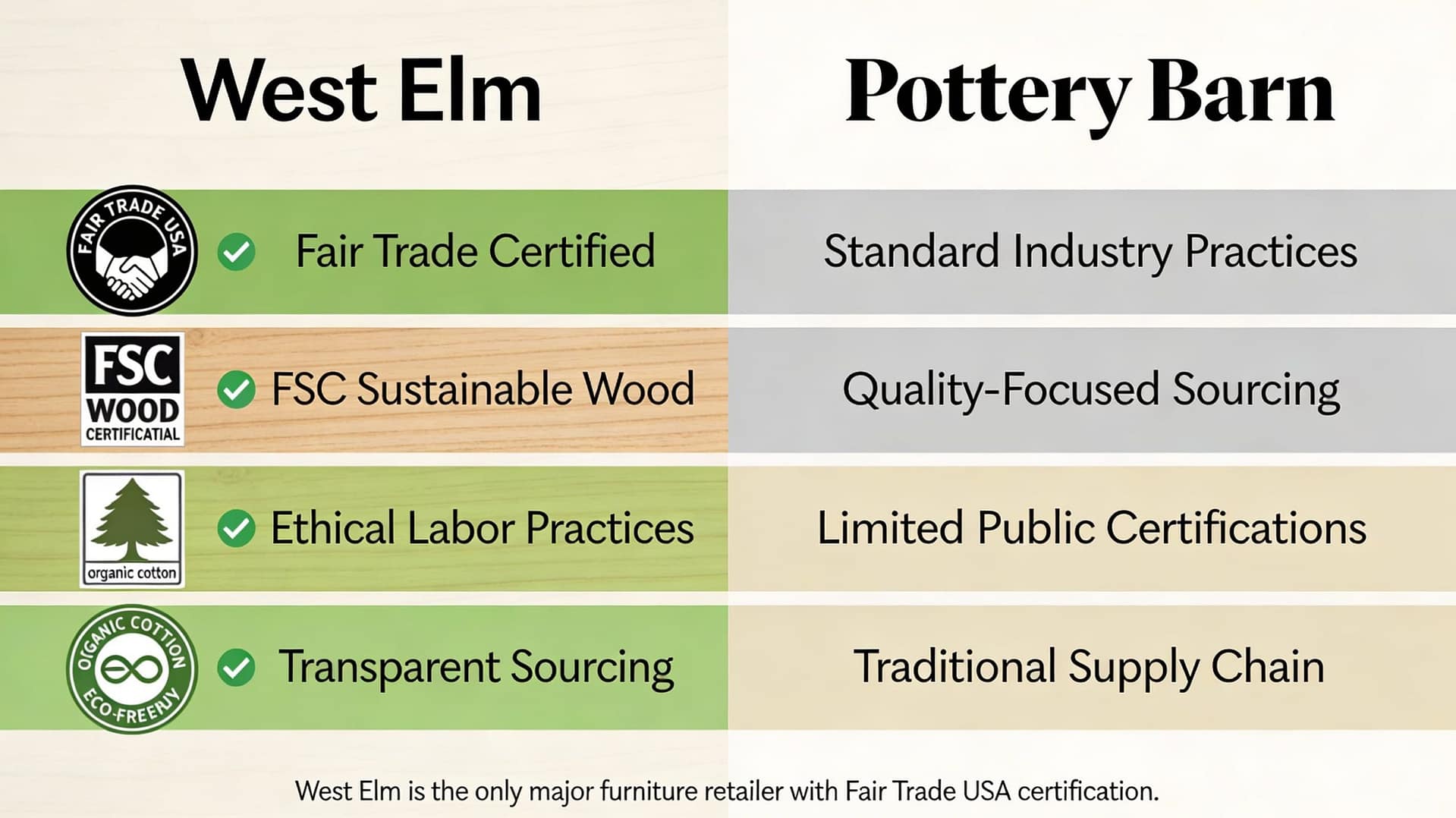
West Elm has improved how they build things. In the past, people worried about how long it lasted. Now, they have much higher standards. They use a mix of solid wood and strong plywood for frames. It might not be as “heavy” as Pottery Barn, but it is plenty tough for most homes. A huge plus is their focus on the planet. They were the first US home store to join Fair Trade USA. They use a lot of wood that is grown safely.
Emma R., an eco-conscious buyer, explained: “I only buy from Fair Trade brands. West Elm was the only big furniture store that could prove their wood sourcing. I paid $1,899 for a dining table knowing the workers were treated fairly. That matters to me more than saving $200.”
This is where the choice between Pottery Barn and West Elm becomes easy for eco-conscious buyers—West Elm’s transparent sourcing and Fair Trade certification make it the clear winner.
West Elm is usually cheaper than Pottery Barn. You can often find a very nice sofa for $1,400 to $2,200. They also have more items ready to ship fast. You might get your new bed in just a few weeks. They offer a huge range of cool fabrics. You can pick from things like “distressed velvet” or “bouclé.” These choices make your room look very high-end.
The Pros:
- Modern Style: Perfect for a mid-century or clean, minimal look.
- Green Focus: They use safe wood and fair labor practices for their goods.
- Small Scale: Their furniture fits well in tight hallways and small rooms.
- Great Fabrics: They have the most trendy and unique cloth options available.
- Good Prices: You get a designer look for a much lower price tag.
- Big Sales: They have deep discounts quite often throughout the year.
The Cons:
- Firm Seating: Their sofas are often firmer and not as deep as others.
- Mixed Quality: Some cheaper items use more glue and thin wood than solid boards.
- Some Assembly: You might have to put smaller items together yourself.
The Honest Verdict:
West Elm is the best choice for city living. It is for people who want a modern look and care about the planet.
Detailed Side-by-Side Comparison
This detailed Pottery Barn vs West Elm breakdown examines everything from frame construction and cushion comfort to sustainability practices and customer service. Use this table to understand exactly where each brand excels and where they fall short.
| Factor | Pottery Barn | West Elm | Winner |
|---|---|---|---|
| Price Point | Mid-to-High ($2,200-$3,500 sofas) | Mid ($1,400-$2,500 sofas) | West Elm |
| Design Style | Traditional / Classic / Coastal | Modern / Contemporary / MCM | Depends |
| Frame Quality | Kiln-dried hardwood | Solid wood + plywood mix | Pottery Barn |
| Cushion Comfort | Deep, soft, sink-in | Firmer, more structured | Pottery Barn |
| Material Options | Excellent (120+ fabrics, 45 leathers) | Good (50+ fabrics) | Pottery Barn |
| Sustainability | Standard sourcing | Fair Trade certified, FSC wood | West Elm |
| Delivery Time (Custom) | 12-16 weeks | 8-12 weeks | West Elm |
| Delivery Time (Stock) | 2-4 weeks | 1-3 weeks | West Elm |
| Customization Depth | Limited (fabric/finish only) | Limited (fabric/finish only) | Tie |
| Warranty | 1 year limited | 1 year limited | Tie |
| Resale Value | 35-45% after 5 years | 25-35% after 5 years | Pottery Barn |
| Customer Service | Excellent (responsive) | Mixed (delays reported) | Pottery Barn |
| Best For | Classic comfort seekers | Modern eco-conscious buyers | Different needs |
Warranty, Returns, And What Actually Happens When Things Go Wrong
Both brands have the same parent company, but customer experiences vary significantly. The Pottery Barn vs West Elm difference shows up most clearly in customer service quality and how each brand handles warranty claims.
Warranty Coverage
Pottery Barn:
- 1 year limited warranty on upholstery and case goods
- Covers manufacturing defects only (NOT fabric wear or normal use)
- Extended warranty available for purchase
West Elm:
- 1 year limited warranty on most furniture
- Same manufacturing defect coverage as Pottery Barn
- Customer reviews report mixed warranty claim experiences
- Some buyers report difficulty getting replacements
Return Policies
Pottery Barn:
- 30 days for non-custom items
- Custom fabric orders are FINAL SALE
- Restocking fees may apply
- Delivery fees are non-refundable
- Excellent customer service reputation
West Elm:
- 30 days for non-custom items
- Custom fabric orders are FINAL SALE
- Restocking fees may apply
- Delivery fees are non-refundable
- Customer reviews report inconsistent service
Real Customer Experiences
Pottery Barn – Positive:
Jennifer L. shared: “My Pottery Barn sofa arrived with a small tear. I called customer service, sent photos, and they shipped a replacement cushion within 10 days at no charge. The whole process was smooth and professional.”
West Elm – Mixed:
Multiple Reddit users report that West Elm orders have been delayed 6+ months with unresponsive customer service. Some had to resort to credit card chargebacks to get refunds.
The Bottom Line on Service
Pottery Barn: Consistently excellent customer service. If something goes wrong, they usually fix it fast.
West Elm: Customer service is hit-or-miss. When it works, it’s fine. When it doesn’t, buyers report months of frustration.
“Independent customer service reviews and consumer advocacy platforms consistently show Pottery Barn receiving higher satisfaction ratings for service responsiveness and issue resolution, while West Elm’s ratings vary significantly based on delivery performance and warranty claim handling.
Pro tip: Always photograph your furniture during unboxing. Report any defects within 48 hours with photos.
Lead Times, Shipping, And Delivery Reality Check
Delivery speed is a major factor in the Pottery Barn vs West Elm comparison, especially if you need furniture quickly. Let’s examine the realistic lead times for both brands and what that means for your purchase decision.
Lead Times
Pottery Barn:
- In-stock items: 2-4 weeks
- Custom fabric items: 12-16 weeks
- Peak season (holidays): Add 2-4 weeks
West Elm:
- In-stock items: 1-3 weeks (faster)
- Custom fabric items: 8-12 weeks
- Peak season: Add 2-3 weeks
- More items kept in stock for faster fulfillment
Real Delivery Experiences
Pottery Barn – Reliable:
Tom R. shared: “Our Pottery Barn dining table took 14 weeks to arrive. The delivery team was professional, placed it exactly where we wanted, and cleaned up all packaging. No issues.”
West Elm – Inconsistent:
Multiple Reddit users report: “We ordered a West Elm sofa in March and it still hasn’t arrived. Customer service keeps saying ‘it will ship soon’ but never gives a real date.”
Delivery Pro Tips
- Measure doorways three times
- Measure stairway turns
- Check ceiling height
- Measure actual room dimensions
A $3,000 sofa is only great if it fits through your door.
Real Product Pricing: What You’ll Actually Pay

Price is often the deciding factor in the Pottery Barn vs West Elm debate. Let’s look at real products so you understand exactly what your money gets you.
Sofas: Side-by-Side
Pottery Barn Pearce Sofa (86″ width)
- List price: $2,799
- Frame: Kiln-dried hardwood
- Springs: Sinuous wire springs
- Seat depth: 25″ (very deep)
- Fabric options: 120+ choices
- Lead time: 12-16 weeks (custom fabric)
- Best for: Deep, sink-in comfort
West Elm Harris Sofa (82″ width)
- List price: $1,799
- Sale price: Often $1,439 (20% off sales)
- Frame: Solid wood + engineered wood
- Springs: Sinuous wire springs
- Seat depth: 22″ (standard)
- Fabric options: 50+ choices
- Lead time: 8-10 weeks (custom fabric)
- Best for: Modern, firm support
Price difference: $1,000-$1,360 (Pottery Barn is 56-95% more expensive)
This $1,000+ price gap perfectly illustrates the core Pottery Barn vs West Elm trade-off: pay significantly more for deeper comfort and longer durability, or save money for modern style and faster shipping.
Dining Tables: Side-by-Side
Pottery Barn Benchwright Extending Dining Table (86″)
- List price: $1,999
- Material: Reclaimed pine wood
- Extends to: 122″ (seats 10-12)
- Lead time: 8-10 weeks
West Elm Industrial Storage Dining Table (72″)
- List price: $1,299
- Sale price: Often $1,039
- Material: Mango wood top + metal base
- Fixed size: 72″ (seats 6-8)
- Lead time: 4-6 weeks (often in stock)
Price difference: $700-$960 (Pottery Barn is 54-92% more expensive)
What a Full Living Room Costs
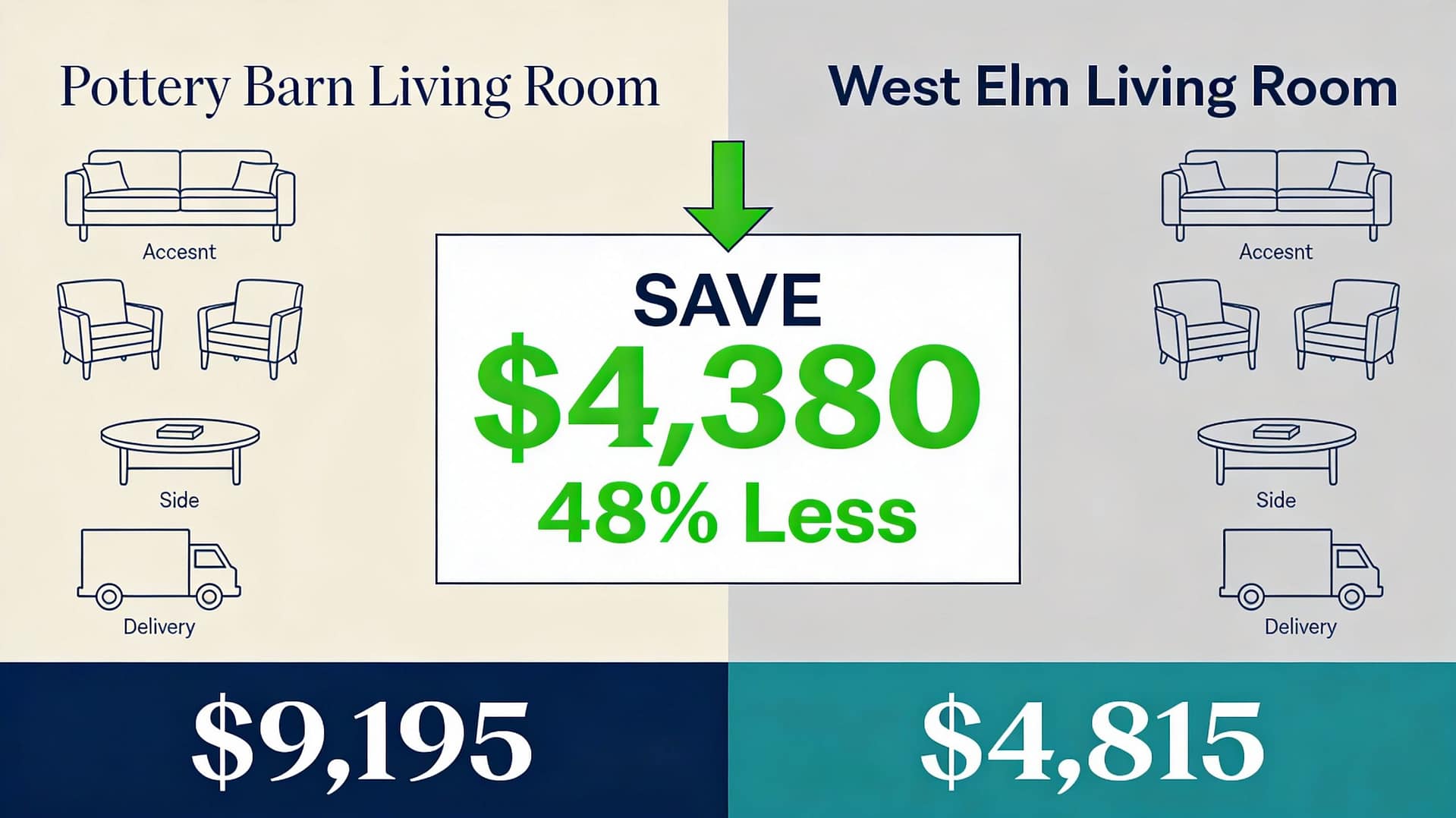
Pottery Barn Living Room Setup:
- Pearce Sofa (86″): $2,799
- 2 Irving Leather Chairs: $4,398 ($2,199 each)
- Benchwright Coffee Table: $999
- Malcolm Side Table: $399
- Delivery: $600
- Total: $9,195
West Elm Living Room Setup:
- Harris Sofa (82″): $1,439 (on sale)
- 2 Andes Leather Chairs: $2,078 ($1,039 each)
- Industrial Coffee Table: $599
- Mid-Century Side Table: $299
- Delivery: $400
- Total: $4,815
You save $4,380 with West Elm (48% cheaper)
This $4,380 savings explains why budget-conscious buyers often look at the price difference between Pottery Barn and West Elm before making a decision.
Which Brand Should You Choose?

You Should Choose Pottery Barn If You’re This Person
The Pottery Barn vs West Elm choice depends entirely on your lifestyle, budget, design preferences, and how long you plan to keep your furniture. Here are four different buyer types and which brand or combination works best for each one.
Your budget is $8,000-$15,000 for the main living spaces. You just bought or inherited a home with traditional architecture. Your ceilings are 9-10 feet tall. You want furniture that looks like it’s always been there, not trendy pieces. You appreciate deep, comfortable seating where you can actually nap. You’re planning to stay in this home for at least 10 years. Quality matters more than being on-trend.
Real Example:
You’re furnishing a 14′ x 18′ formal living room in your newly purchased colonial-style home. You need a sofa that fills the space without looking small. You visit Pottery Barn and fall in love with the Pearce Sofa in Belgian linen. You add two Irving leather chairs, a Benchwright coffee table, and two table lamps. With delivery, you spend $8,594—right in line with the Pottery Barn living room setup we showed earlier, but personalized to your taste.
The room feels complete from day one. Guests comment on how “expensive” it looks. Five years later, everything still looks showroom-perfect because the frames are solid and the cushions haven’t sagged. When you check resale values, similar used Pottery Barn sofas are selling for $1,200-$1,500 (43-54% of what you paid).
Why Pottery Barn works for you: Timeless style, deep comfort, solid construction, high resale value, and that “established home” feeling. This is the classic Pottery Barn vs West Elm decision—traditional comfort versus modern style.
You Should Choose West Elm If You’re This Person
You’re working with $4,000-$8,000 for main living spaces. You live in a city apartment or modern condo with 8-9 foot ceilings and open floor plans. You love mid-century modern aesthetics. You want your home to look like it belongs on Instagram or in Dwell magazine. You care about sustainability and only buy from ethical brands. You’re okay with firmer seating if it means the sofa won’t sag in year two. You hunt for sales and don’t mind waiting for the right deal.
Real Example:
You’re furnishing a 12′ x 14′ living room in your downtown loft. The ceilings are 8.5 feet and the room has huge windows. You visit West Elm during their Labor Day sale and find the Harris Sofa (82″) on sale for $1,439 (was $1,799). You add two Andes leather chairs on sale ($1,039 each), a modern coffee table ($599), and a brass floor lamp ($299). With delivery, you spend $4,415.
The room looks incredible—modern, airy, and very “design-forward.” Your friends ask if you hired a designer. The sofa is firm, which you actually prefer because it keeps its shape. Two years later, everything still looks great. You didn’t want a sofa forever anyway; you’ll probably move in 3-5 years.
Why West Elm works for you: Modern style, smaller scale, eco-friendly, $4,000 less than Pottery Barn, and you got the Instagram-worthy look you wanted. For city dwellers with limited space, the decision between Pottery Barn or West Elm is straightforward: West Elm’s smaller-scale furniture fits urban apartments perfectly while Pottery Barn’s oversized pieces would overwhelm a city loft.
You Should Choose West Elm If Sustainability Is Your Top Priority
You only buy from brands with clear ethical sourcing policies. Fair Trade certification matters to you. You want to know exactly where your wood came from and that workers were paid fairly. You prefer organic fabrics and FSC-certified wood. You’re willing to pay a bit more for peace of mind that your furniture didn’t harm the planet or exploit workers.
Real Example:
You’re furnishing your first home after years of thrifting and secondhand shopping. You finally have the budget to buy new, but you refuse to support fast furniture or unethical brands. You research for weeks and discover West Elm is Fair Trade USA certified—the only major furniture retailer with that certification.
You buy the Mid-Century Dining Table in FSC-certified walnut ($1,899), six dining chairs in organic cotton upholstery ($1,794 total), and a reclaimed wood console table ($799). With delivery, you spend $4,592. Yes, you could have saved $800 at a different store, but you sleep well knowing workers were paid fairly and the wood was sustainably sourced.
When friends ask about your furniture, you proudly explain the Fair Trade certification and FSC wood. Several of them switch to West Elm after learning about it. You’ve become an unofficial ambassador for ethical furniture shopping.
Why West Elm works for you: Fair Trade certified, FSC wood options, organic fabric choices, transparent sourcing, and peace of mind.
You Should Mix Both Brands If You’re Strategic About Budget
You’re planning to spend $10,000-$12,000 across multiple rooms. You understand that not all furniture needs to be “forever quality.” You’re comfortable mixing brands if it means getting luxury where it counts and value where it doesn’t. You want your home to look curated and collected, not like it all came from one store. You’re willing to hunt for sales and wait for the right pieces.
Real Example:
You’re furnishing a 3-bedroom home on a $11,000 budget. You want high-impact pieces in high-use rooms, but you’re smart about where to save.
Pottery Barn splurges (high-impact areas):
- Master bedroom: Pottery Barn bed frame ($2,199) + nightstands ($798)
- Formal dining: Pottery Barn extending dining table ($1,999)
- Investment: $4,996
West Elm saves (lower-impact areas):
- Family room: West Elm Harris Sofa on sale ($1,439)
- Guest bedroom: West Elm bed frame ($799) + nightstand ($299)
- Accent chairs: Two West Elm leather chairs ($2,078)
- Lighting: West Elm modern chandelier ($599)
- Investment: $5,214
Total spent: $10,210
What you got: Your master bedroom and dining room look incredibly high-end (Pottery Barn quality). Your family room and guest spaces look modern and stylish (West Elm). Nobody can tell you mixed brands—the house looks professionally designed. You saved $3,000-$4,000 compared to buying everything from Pottery Barn.
Why mixing works for you: Maximum impact per dollar, curated “collected over time” look, luxury where guests see it most, value where it matters less.
Pro designer tip from Lisa K.: “I tell every client: Pottery Barn for dining tables, beds, and pieces you’ll use daily for 10+ years. West Elm for sofas, accent chairs, lighting, and pieces you might swap out in 5-7 years. This strategy saves thousands and creates homes that feel layered and interesting, not catalog-flat.”
Frequently Asked Questions
These are the most common questions people ask when researching Pottery Barn vs West Elm online. Below, you’ll find straightforward answers based on real customer experiences and product specifications.
Do Pottery Barn sofas sag over time?
Less than West Elm sofas, according to customer reviews. Pottery Barn uses kiln-dried hardwood frames and higher-density cushion foam. Most owners report 5-7 years before noticeable sagging. West Elm sofas can sag within 2-4 years. If you want a sofa that lasts 10+ years, Pottery Barn is the safer bet.
Can I negotiate prices at either store?
Not really. Both brands have strict pricing policies. Your best strategy is to wait for sales:
- Pottery Barn: Major sales 4-5 times per year
- West Elm: Sales monthly, with biggest discounts during Labor Day and Black Friday
- Sign up for email lists to get early access
Which brand has better fabric quality?
Pottery Barn has more options (120+ fabrics, 45 leathers) and slightly thicker upholstery. West Elm has fewer options but they’re still good quality. Pottery Barn performance fabrics hold up better over 5+ years. If you have young kids or large dogs, Pottery Barn fabrics are worth the extra cost.
Which brand has better furniture quality?
It depends on what you buy. For big sofas and beds, Pottery Barn is usually a bit tougher. For desks and shelves, West Elm has some great solid wood options. Both are much better than “fast furniture” stores.
Is West Elm better than Pottery Barn?
Not really. One is not “better” than the other. West Elm is better for style and the planet. Pottery Barn is better for long-lasting comfort. If you have a small space, pick West Elm. If you have a big house, pick Pottery Barn.
Which brand ships faster?
West Elm is usually faster. They keep more items in stock and ready to go. Pottery Barn does more custom work. That means you will wait longer for your items to be built and shipped.
Are Pottery Barn sofas worth the high price?
Yes, if you want a deep, soft seat. You are paying for a very strong wood frame. If you keep the sofa for ten years, it is a great deal. It won’t sag or break like cheap sofas do.
How do the return policies work?
Both stores have the same parent company. You usually have 30 days to return most items. But be careful. If you order a custom fabric, you usually cannot return it. Always check before you pay.
Which brand is more eco-friendly?
West Elm is the winner here. They work hard on Fair Trade and safe wood goals. Pottery Barn is trying to get better, but they are behind West Elm. If being “green” is your top goal, go with West Elm.
How to Mix Both Brands (Smart Design Strategy)
You don’t have to pick just one brand or limit yourself to a single store. Smart designers mix Pottery Barn and West Elm all the time to create homes that look curated and expensive without being catalog-flat. If you buy every piece from one store, the room feels flat. Mixing old and new styles is the easiest way to look like a pro. This keeps your home from feeling like a store display. For more mixing strategies, see our high-low design mixing guide.
Let’s look at a real example. Imagine you buy a heavy Pottery Barn dining table ($2,500). That wood will last for a thousand dinners. To make it look fresh, add four West Elm chairs ($400 each). These chairs have sleek legs that pop. Add a modern West Elm light fixture ($800) above the table. Then, put a soft Pottery Barn rug ($1,200) on the floor. For about $6,100, you have a room that looks amazing.
Why does this work so well? It is simple. Classic pieces give the room a “base.” Modern pieces give it “life.” The Pottery Barn items are the bones of the room. They are hard to move and stay for years. The West Elm items add the style. This mix makes your home feel expensive and well-planned. It is a smart way to use your budget.
Pottery Barn vs West Elm: Final Verdict
In the Pottery Barn vs West Elm battle, there’s no universal winner—only the right choice for your specific situation. Whether you choose Pottery Barn for classic comfort or West Elm for modern style, the best decision is the one that fits your life, budget, and design preferences.
Choose Pottery Barn If:
You have $8,000-$15,000 to spend on main living spaces. You want furniture that lasts 10-15 years without sagging or breaking. You love classic, traditional style that never goes out of fashion. You have large rooms with 9-10 foot ceilings that can handle deep, substantial furniture. You value excellent customer service and reliable delivery. You’re planning to stay in this home long-term. Resale value matters to you.
Real outcome: You’ll spend more upfront, but you’ll have furniture you can pass down to your kids or resell for 40-50% of what you paid. Your home will feel established and comfortable from day one. You won’t need to replace anything for a decade.
Choose West Elm If:
You have $4,000-$8,000 to spend on main living spaces. You live in a city apartment or modern home with 8-9 foot ceilings. You love mid-century modern, contemporary style. You care deeply about sustainability and ethical sourcing (Fair Trade certified). You’re okay with firmer seating that won’t sag quickly. You hunt for sales and don’t mind waiting for deals. You might move in 3-5 years and need furniture that fits smaller spaces.
Real outcome: You’ll spend 40-50% less than Pottery Barn and get a modern, Instagram-worthy look. Your furniture will last 5-7 years before needing replacement (which is fine since you like updating your style anyway). You’ll sleep well knowing your money supported Fair Trade practices.
Mix Both Brands If:
You’re strategic about where to splurge and save. You have a $10,000-$12,000 total budget across multiple rooms. You understand that not every piece needs to be “forever furniture.” You want a home that looks curated and collected, not catalog-flat.
Smart mixing strategy:
- Pottery Barn for: Master bedroom beds, formal dining tables, main living room seating
- West Elm for: Guest bedroom furniture, accent chairs, lighting, family room sofas, consoles
Real outcome: You’ll save $3,000-$5,000 compared to buying everything from Pottery Barn. You’ll get way better style than buying everything from a budget brand. Your home will look professionally designed because it’s layered and interesting.
The Honest Truth
Most professional designers mix brands. Your home doesn’t need to come from one store. Here’s the reality:
- If you have kids and pets: Pottery Barn holds up better over 10 years
- If you’re renting or might move: West Elm makes more sense
- If sustainability is priority #1: West Elm is the only Fair Trade certified option
- If you want deep, sink-in comfort: Pottery Barn sofas are 2-3 inches deeper
- If you have $15K+ budget: Pottery Barn across the board
- If you have $5K budget: West Elm is your best option
- If you have $10K budget: Mix both strategically
Ready to Start Shopping?
Shop Pottery Barn:
- Sofa Collections – Starting at $1,799
- Dining Tables – Starting at $999
- Bedroom Furniture – Starting at $1,299
Shop West Elm:
- Modern Sofas – Starting at $1,199
- Dining Tables – Starting at $799
- Bedroom Furniture – Starting at $899
- Sale Section – Up to 60% off
Need More Brand Comparisons?
- Complete Furniture Brand Comparison Guide – Compare Pottery Barn, West Elm, RH, Arhaus, Crate & Barrel, and more
- Brand Comparison Hub – All our detailed brand guides in one place
One Final Pro Tip
Walk through your home with a tape measure before you buy anything. Measure:
- Doorways (most sofas are 35-40″ wide)
- Stairway turns (sofas often get stuck here)
- Ceiling height (low ceilings overwhelm with deep sofas)
- Actual room dimensions (sofas look smaller in showrooms)
A $3,000 sofa is only great if it actually fits through your front door.
Good luck, and happy furniture shopping! Remember, both Pottery Barn and West Elm make excellent furniture—the right choice is simply the one that aligns with your lifestyle, budget, and aesthetic vision. If this guide helped, check out our other furniture brand comparison guides for more decision-making help.