

RH vs Pottery Barn has buyers staring at two sofas. One costs $6,800. The other? $2,900. Same look. Huge price gap. Is the luxury brand really worth double?
You’ve got two tabs open. One shows an RH sectional. The other has what looks like the same sofa from Pottery Barn—but for less than half. You’ve been staring at both for twenty minutes.
That’s exactly what these brands want. RH makes you feel the price gap is obvious and earned. Pottery Barn makes you feel you’re getting almost the same thing for less. Which one’s telling the truth? It depends on what you’re buying.
We checked the build specs. We read real owner reviews. We found where each brand holds up—and where they fail. Here’s what we found.
Ready to see what this price gap looks like in real sofas? Check current Pottery Barn sofa prices or browse RH-style dupes for less before you read on.
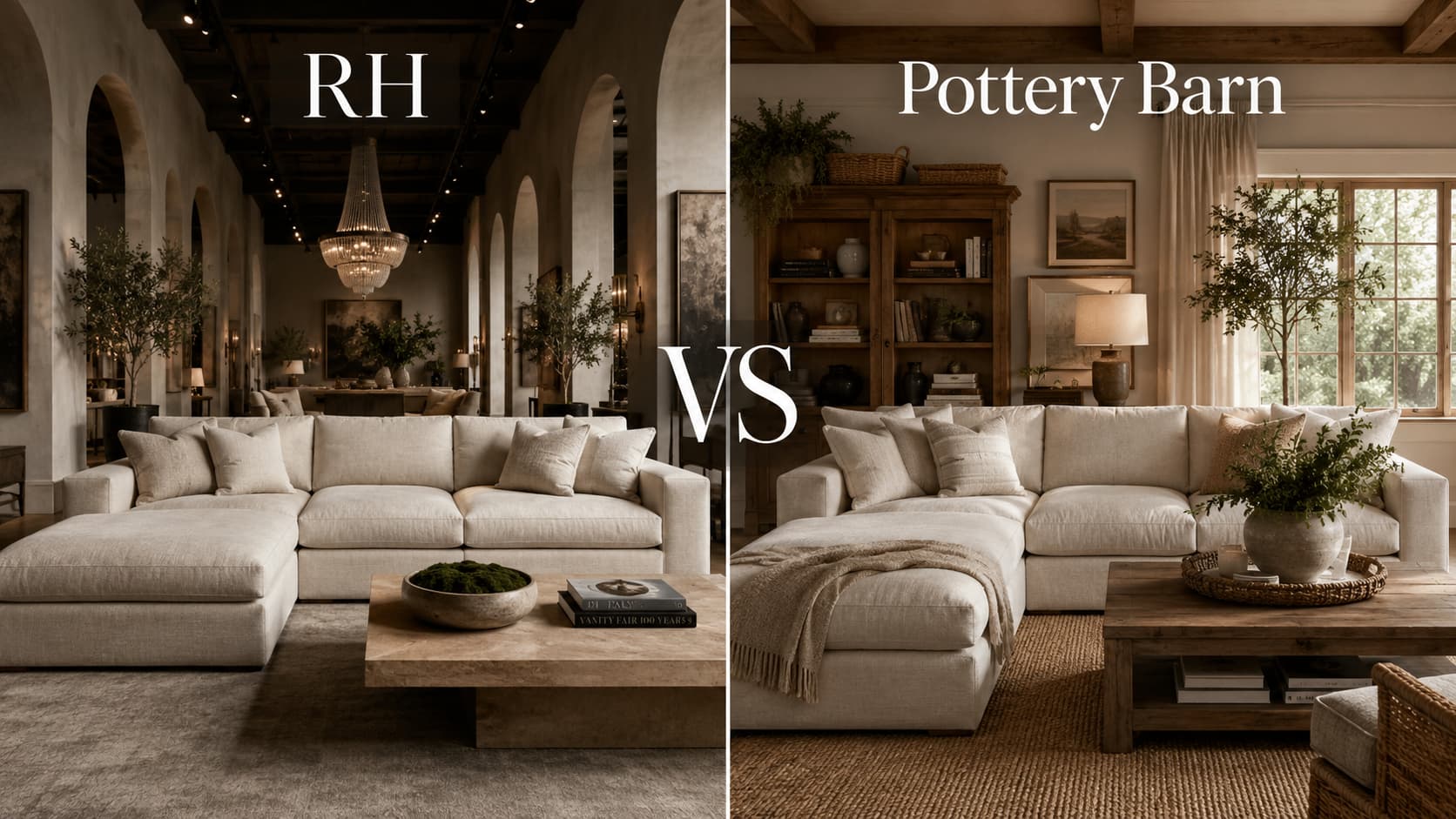
RH vs Pottery Barn at a Glance
RH builds better furniture overall. Especially sofas, solid wood tables, and accent chairs. The materials are good. The quality shows over time.
But that premium isn’t the same everywhere. RH sells accessories, lighting, and cheap lines. They use the same MDF and veneers you find at mid-range stores. But they charge luxury prices. So you need to know what you’re buying before you spend that money.
Pottery Barn gives solid, honest quality for its price. Most sofa frames use kiln-dried hardwood. Performance fabrics are excellent, especially for families. On bedroom furniture, rugs, and accessories, the quality gap gets small. But the price gap stays big.
| Category | Restoration Hardware (RH) | Pottery Barn |
|---|---|---|
| Price (sofas) | $3,000–$10,000+ | $1,500–$4,000 |
| Sofa frame | Kiln-dried solid hardwood | Kiln-dried hardwood |
| Tables & storage | Solid hardwood (premium) | MDF/veneer heavy |
| Leather | Top-grain, full-grain | Good; strong performance range |
| Performance fabrics | Available | Wider range, more family options |
| Sofa life | 15–20+ years (premium) | 7–12 years (typical) |
| Wait time | 12–16+ weeks | 2–4 weeks |
| Sales | Members-only ($175/yr, 25% off) | Sitewide 20–40% off |
| Service | Inconsistent | More reliable |
| Certifications | Responsibly sourced | GREENGUARD Gold on many |
Ready to see current prices? Browse RH-style sofas for less → or See Pottery Barn sofas on sale. Prices and availability change frequently — always check before buying.
What Each Brand Actually Is
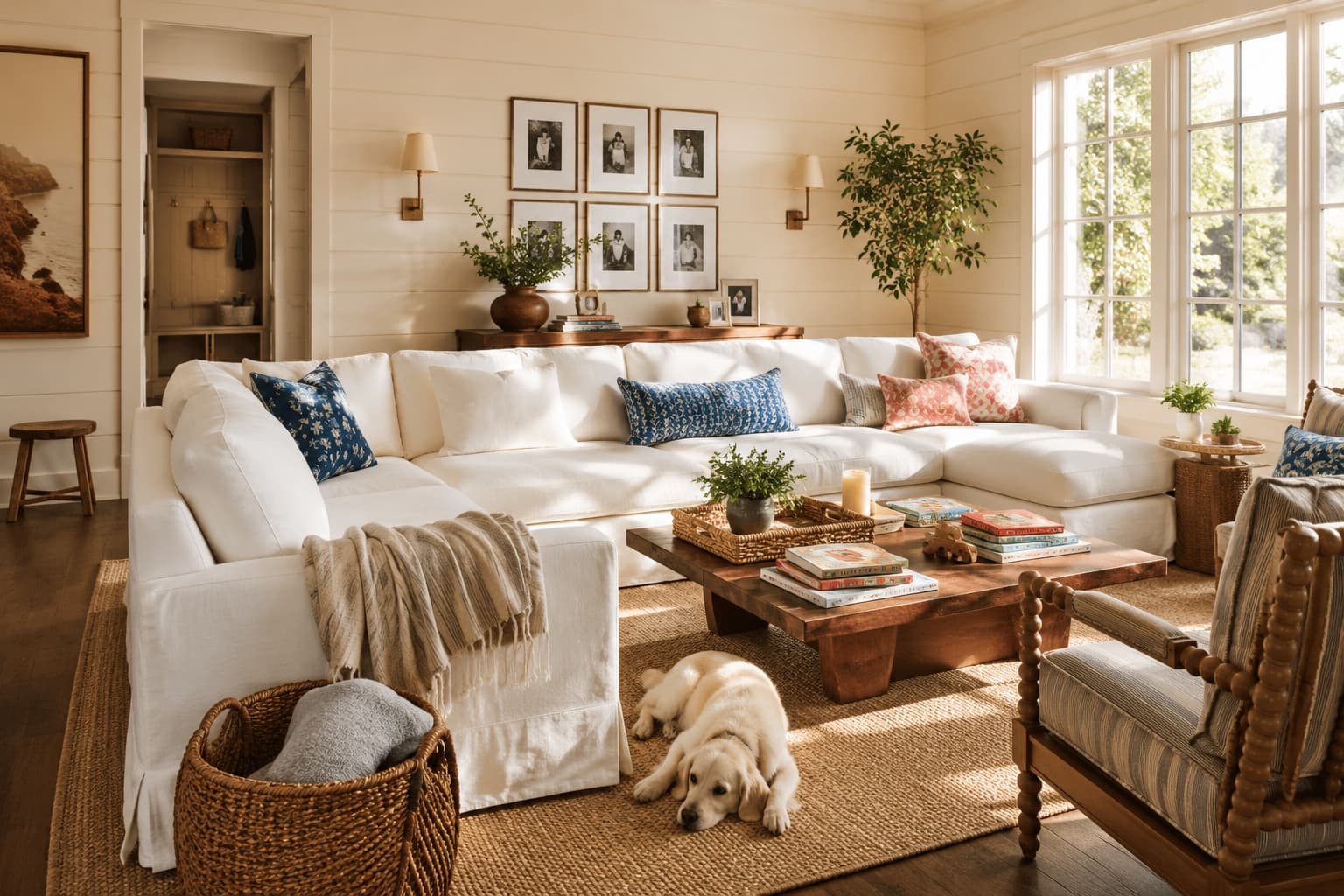
You can’t compare these fairly without knowing what they’re trying to be. And honestly? They’re playing different games.
Restoration Hardware (RH)
RH (formerly Restoration Hardware) turned itself from a retail chain into a luxury brand over the last decade. Their stores look like galleries. They print sourcebooks, not catalogs. Prices aren’t on the floor—you have to ask. The whole thing feels exclusive. Gary Friedman, RH’s CEO, said the brand competes with luxury hotels, not furniture stores. Love or hate that vibe? It tells you if RH is right for you.
Pottery Barn
Pottery Barn goes the opposite way. It wants to feel warm, easy, and achievable. Styles go from coastal to farmhouse to modern classic to traditional. Built for everyone, not just one buyer. The idea is simple: you can have a stylish home without a decorator or a huge budget. They run sales all the time. They have kids and teen lines. At heart, it’s a family lifestyle brand with great design.
If you want to see what that looks like in actual rooms, check Pottery Barn’s Comfort sofa and Pearce sofas for real-world examples of that “warm, achievable” vibe.
Neither is a criticism. They’re just different answers to different questions.
Materials and Build: The Honest Breakdown
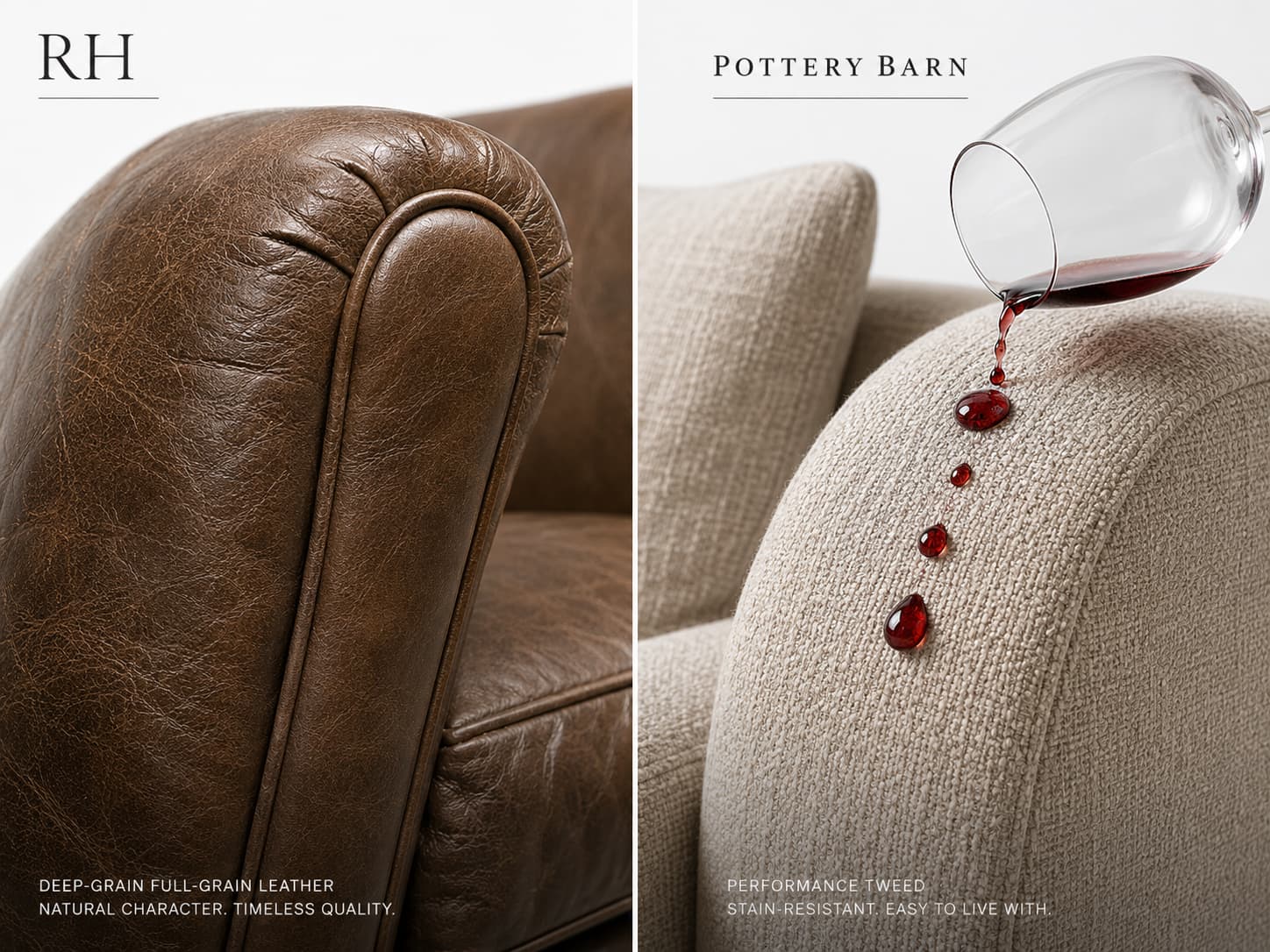
This is where the real story lives. Let’s go piece by piece.
Wood Frames and Case Goods
For sofas, both use kiln-dried hardwood frames as standard. Kiln-drying removes moisture. Without it, frames warp, crack, and joints fail over time. At this level, the brands are closer than the price says. RH uses slightly heavier timber on premium lines. But in a normal home, you’d need to own both for ten years to feel the difference.
For case goods—dining tables, dressers, sideboards—the gap is bigger. RH’s premium lines use solid hardwood all the way through. Pottery Barn uses a lot of MDF with wood veneer on top. This is normal at mid-range prices. It looks great in a showroom. But MDF doesn’t handle daily wear like solid wood. In humid rooms or with heavy use, PB veneer pieces can chip, swell, or show damage in three to five years.
Key takeaway: Buying a sofa? The gap is real but smaller than the price. Buying a dining table? The gap is wide. The higher RH price is more earned.
Examples worth comparing side by side:
Upholstery and Fabric
RH upholstery:
- Top-grain and full-grain leather on all leather lines
- High-density foam with down/feather blend toppers
- European and Belgian linen on flagship collections
- Hand-forged brass and steel on accent pieces
- Watch out: some fabrics snag, pill, and wear faster than the price says
Pottery Barn upholstery:
- Kiln-dried hardwood frames with sinuous springs
- Wide range of performance fabrics—stain-resistant, pet-friendly, washable
- GREENGUARD Gold on many lines (great for families)
- Wide slipcover options—washable, easy to replace
- Watch out: standard fabrics can show wear in 4–6 years in busy rooms
If performance fabrics are non‑negotiable for you, start with Pottery Barn’s performance sofa lineup and, if that’s still a stretch, check Amazon sofas with RH-style looks and stain-resistant fabrics .
Pottery Barn beats RH on performance fabrics. If you have kids, pets, or a sofa that gets real use, PB’s stain-resistant, washable options are better and cheaper. That’s not small. It’s one of the most important things for a sofa that still looks good in year seven.
The Quality Floor Problem
Here’s something to know: both brands have a quality floor problem. But RH’s costs more. RH sells lamps, vases, textiles, and decor. They use the same materials as mid-range stores: MDF, veneers, basic fabrics. But the price says luxury. The brand name does heavy lifting here.
At Pottery Barn, you mostly know what you’re getting. At RH, check specs carefully. That gorgeous table might be solid walnut. Or it might be a well-shot veneer.
Once you know how to read specs, compare a solid-wood Pottery Barn table with an RH-style table from WayfairAmazon to see how construction changes at different price points.
Category by Category: Where Each Brand Wins
| Category | Winner | Why |
|---|---|---|
| Sofas & sectionals | RH ✓ | Better materials, longer life on flagship. Gap narrows for daily use. |
| Dining tables | RH ✓ | Solid hardwood vs. PB’s MDF/veneer. Big difference over years. |
| Dining chairs (upholstered) | PB ✓ | PB’s performance fabrics are more practical. RH looks great but not for eating. |
| Bedroom furniture | PB ✓ | Gap shrinks. PB gives similar quality at lower price. |
| Accent chairs | RH ✓ | Fabric and frame quality better. Best buys at RH. |
| Rugs | PB ✓ | Gap almost disappears. PB rugs on sale hold up well. |
| Bedding & textiles | PB ✓ | Strong quality for price. RH can be great, but gap doesn’t match cost. |
| Outdoor furniture | Tie | Both solid. Pick based on style and sales. |
| Accessories & decor | PB ✓ | RH accessories are standard quality at luxury prices. PB is honest. |
Shop smart in each category:
- Sofas & sectionals: Pottery Barn sofas (best balance of quality & price) and RH-style sofa dupes if you’re on a tighter budget.
- Dining tables: Pottery Barn dining tables or solid-wood RH-lookalikes on Wayfair.
- Dining chairs, rugs, textiles: Pottery Barn dining chairs, rugs , and bedding & textiles .
Price and Value: Is the Gap Actually Justified?
Let’s look at real numbers. An RH sofa starts at $3,000. It hits $6,000–$10,000 for sectionals. A similar Pottery Barn sofa runs $1,500–$4,000. That’s 2–3x the price.
Here’s a better way: cost per year. A $6,000 RH sofa lasting 20 years costs $300/year. A $2,200 Pottery Barn sofa lasting eight years costs $275/year. They’re almost the same. But only if the RH piece actually lasts. That depends on what you buy and how you live.
Is RH Membership Worth It?
If you buy RH, join the Members Program. It’s about $175/year. You get 25% off full-price items. On a $1,000 purchase, it pays for itself. On a $5,000 sofa, you save $1,250.
Pottery Barn has no membership. But they run sitewide sales of 20–40% off several times a year. No fee. Time your buy to a sale. You close the price gap a lot.
Smart rule: Never buy full price. For RH—join before any purchase over $700. For Pottery Barn—wait for a sale. They happen around Memorial Day, Labor Day, and after holidays.
Related: When to Splurge on Furniture Guide
Love the RH Look, But Not the Price?
If both RH and Pottery Barn are pushing your budget, these RH-style sofas from more affordable retailers might fit better.
- Wayfair RH-Inspired Sectionals
Cloud-style sectionals with deep seats and slipcovers at a fraction of the price.
Browse RH-style sofas on Wayfair → - Amazon “Cloud” Sofa Dupes
Modular sofas and sectionals with that same pillowy, sink-in look.
See Amazon RH Cloud dupes → - More RH Dupes & Styling Ideas
Coffee tables, lighting, rugs and more that give you the RH aesthetic for less.
Visit our full RH dupes guide →
Durability: How Long Will It Actually Last?
This is where RH earns its price—on the right products. A solid hardwood RH dining table or top-grain leather sofa, cared for, looks great in 15–20 years. Solid wood builds character. Good leather softens and deepens. These are heirloom pieces—but only in the right categories.
Pottery Barn at its best—a tough fabric sofa or solid wood bed frame—holds up 8–12 years in a family home. That’s honest, reliable furniture. Nothing to sneeze at. The weak spots are MDF case goods: dressers, sideboards, media consoles. They look great at first but show damage faster.
Buying for a forever home? The durability gap matters. If you move often or change style, Pottery Barn’s lower cost fits better.
Care matters: Conditioning leather, using the right cleaner, protecting wood from moisture can double a piece’s life. See our Care Hub for guides.
Pro tip: Proper care can double furniture lifespan. Use the right cleaning and conditioning products for your investment pieces.
- Leather Care Kit (for PB and RH-style sofas)
- Wood Conditioner for dining tables and coffee tables
- Fabric Protection Spray (pet- and kid-friendly)
Customer Service: The Part Nobody Talks About
This is where the review parts ways with brand marketing. And it matters more than most buyers expect.
RH: Beautiful Stores, Uneven Service
Custom RH pieces take 12–16 weeks. Delays happen. If buying for move-in, order early. Get a named contact at the showroom. Don’t rely on general service.
After the sale, RH service is hit or miss. Long-time buyers with showroom relationships get great treatment. Newer buyers or anyone with a defect face slow replies, low-ball offers, processes dragging months. Reviews show fabric problems, damaged pieces, responses not matching the luxury image. This doesn’t happen to everyone. But it happens enough to plan for.
Pottery Barn: More Predictable, More Forgiving
Most Pottery Barn items arrive in 2–4 weeks. Much faster than RH. Their service isn’t amazing, but it’s more consistent. Returns, exchanges, defect claims get handled with less friction. If something arrives damaged, the fix is usually straightforward.
If you want a smooth experience—or can’t manage a complicated problem—Pottery Barn is lower risk. Even if it gives up some raw material quality.
Style: Which Brand Fits Your Home?
The RH Look
- Grand, sculptural, monochromatic—”expensive hotel lobby” feel
- Palette: warm whites, deep greiges, aged leathers, raw linen
- Big statement pieces needing room to breathe
- Best in large, open spaces
- Very cohesive—harder to mix with other brands
- 2026: quiet luxury, material quality, heirloom feel
The Pottery Barn Look
- Warm, layered, flexible—coastal to farmhouse to modern classic
- Easy to mix with other brands and pieces you own
- Works in more room sizes
- Updates styles often, tracks trends
- PB Kids and Teen for whole-home styling
- 2026: natural textures, performance materials, family comfort
Many designers anchor a room with one or two RH pieces. Then layer everything else from Pottery Barn. One RH sofa as the statement. Pottery Barn chairs, rugs, textiles to fill it out. The result looks better than an all-RH room. And costs less.
Related: High-Low Design: How Designers Mix Luxury and Budget Pieces — and our RH Cloud Sofa Dupes roundup if you love the RH look but not the price.
Final Verdict: Which Should You Actually Buy?
The honest answer: it depends on what you’re buying, how you live, and where you are in your home. Here’s the framework.
Choose RH if…
- You’re buying a sofa or table to keep 15+ years
- Your home has space for RH’s large pieces
- You can wait 12+ weeks without stress
- You have (or can build) a showroom contact
- Your purchase is big enough that membership saves money
- You’re shopping sofas, solid wood tables, accent chairs
Choose Pottery Barn if…
- You have kids, pets, or furniture gets real use
- You need delivery in a few weeks
- You’re furnishing a bedroom, buying rugs, shopping textiles
- You want to change style later
- You want reliable service if something goes wrong
- You’re buying case goods where PB’s quality is close and price wins
Consider both if…
- You’re doing a full room. Use RH for one or two anchor pieces (sofa or dining table). Use Pottery Barn for chairs, rugs, bedding, accessories. This high-low mix is what designers do. The result is more interesting.
Ready to turn this into a shopping list?
Check current Pottery Barn sofa prices →
See RH-style sofa dupes for less→
Our Honest Verdict
RH wins on sofas, solid wood tables, accent chairs. Materials are better. Longevity is real, if you shop right.
But Pottery Barn is more honest. It gives good quality for its price. It beats RH where RH overcharges. It gives a smoother experience. It’s not lesser furniture. It’s differently positioned.
Spend RH budget on the sofa and table. Spend Pottery Barn budget on everything else. That’s the move.
FAQs
Is RH better quality than Pottery Barn?
Yes—for sofas, dining tables, accent chairs. RH uses solid hardwoods and better leather. Pottery Barn only has these on top lines, or not at all. Gap shrinks on bedroom, rugs, textiles, accessories.
Is Pottery Barn worth the money?
Yes, for its price. Kiln-dried frames, performance fabrics, GREENGUARD Gold give it solid quality. Buy on sale and value gets better—especially for families needing washable materials.
Is RH overpriced?
On core furniture and solid wood, no. Build justifies the price. On accessories, lighting, textiles, cheap lines, yes. RH uses standard materials at luxury prices. Check specs before buying.
How long does Pottery Barn last?
Sofas: 7–12 years with normal use. Solid wood bed frames last longer. MDF dressers show wear faster, especially in humid rooms. Replace in 5–7 years.
Can you mix RH and Pottery Barn?
Yes—and designers recommend it. Use RH for anchor pieces (sofa or dining table). Use Pottery Barn for chairs, rugs, textiles, accessories. Styles work together. The mix looks more interesting.